Election campaigns are designed to move quickly.
Announcements arrive, headlines sharpen them, opponents respond, commentators declare winners and losers, and social media turns complicated choices into fragments of approval or outrage. Before we have found the original policy—or understood what it might actually do—we are encouraged to form an opinion.
The pressure is not simply to pay attention. It is to react.
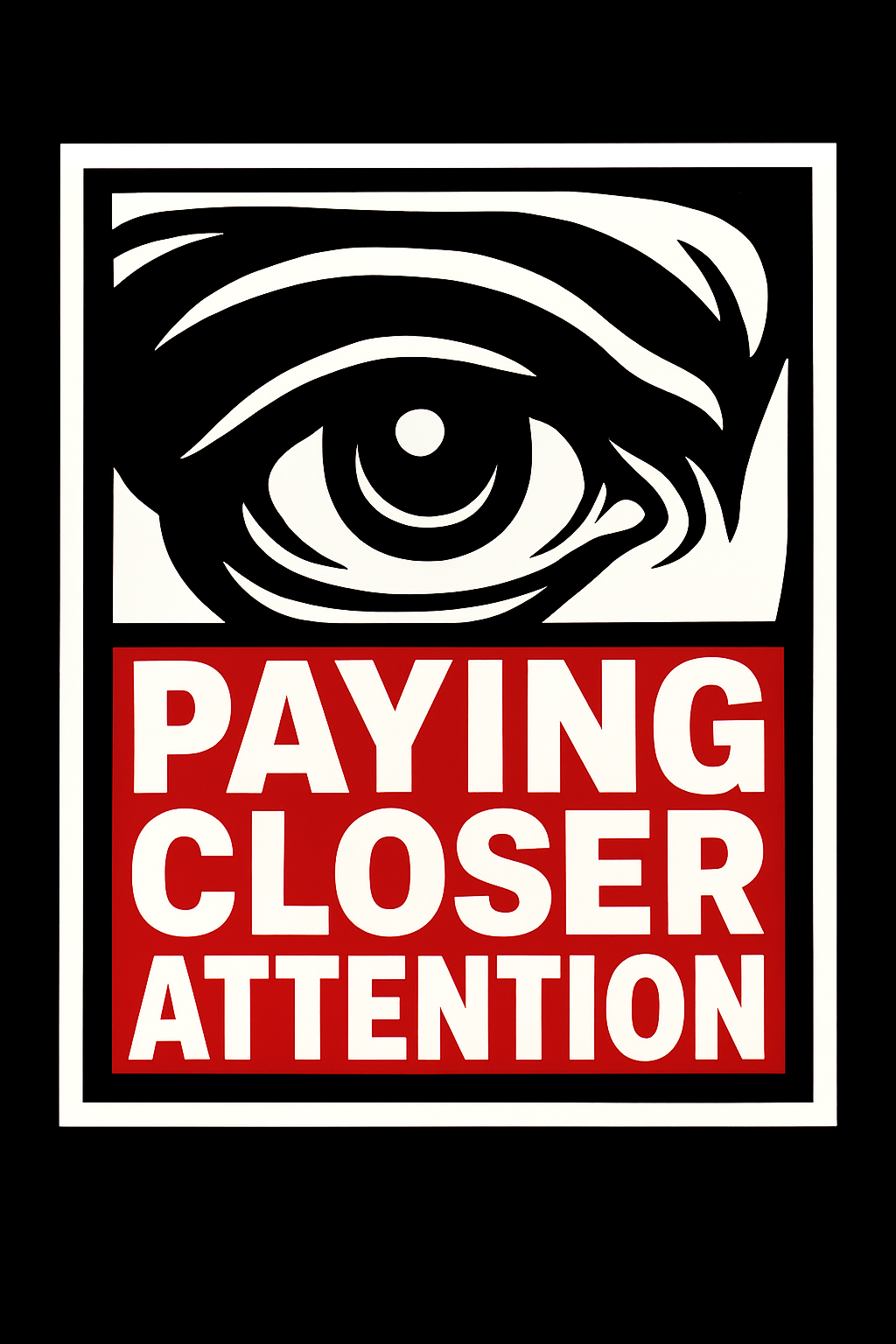
Paying Closer Attention begins with a different proposition: that democracy needs more from us than following the campaign, recognising the personalities and deciding which side we are on.
It asks us to slow down enough to examine what political parties are proposing, what assumptions sit beneath those proposals, and what kind of future their choices might produce.
This does not mean becoming a policy expert. Nor does it require us to suspend our values or pretend that every political position is equally defensible.
It means taking our own judgment seriously.
The announcement is only the beginning
A political announcement tells us what a party wants us to notice.
It will usually name a problem, present an action and describe a desirable outcome. What it may not explain is why the problem exists, how the proposed response will work, who will be responsible for delivering it, or what else might change as a consequence.
These omissions are not always deliberate. Public policy is difficult. Some proposals are announced before their design is complete. Others express a genuine direction without yet providing a credible route for getting there.
But the distinction matters.
An aspiration is not the same as a designed policy. A designed policy is not the same as a delivery plan. And a delivery plan is not evidence that something will work as intended.
If we treat all four as equivalent, we risk evaluating political confidence rather than governing capacity.
Paying closer attention means asking what is actually available for us to assess.
Is this an idea? Does it describe a mechanism? Are the important rules and parameters clear? Does it explain funding, timing, responsibility and transition? Has anything similar been tried—and what happened?
These questions do not tell us whether to support the proposal. They help us understand what kind of promise we are being asked to believe.
Policies contain stories about the world
Every policy begins with a diagnosis.
It tells a story—sometimes explicitly, sometimes silently—about what the problem is, what caused it and what should change.
A housing policy might understand the crisis as a shortage of homes, a failure of affordability, an outcome of land speculation, a consequence of inequality, or some combination of these. Each diagnosis leads toward different interventions.
A food policy might focus on prices, competition, production, household income, ecological limits, ownership or access to land. Again, what becomes possible depends on which parts of the problem are visible.
A policy can be delivered exactly as designed and still deepen the problem if its original diagnosis was too narrow.
Paying closer attention therefore means looking beneath the proposed solution and asking what the policy believes is happening, what it treats as the cause, what relationships it reveals—and which ones disappear from view.
Follow what moves
Policies do more than distribute money or provide services. They alter relationships.
They can concentrate or disperse power. They can increase people’s practical agency or make them more dependent on distant institutions. They can strengthen public capacity or transfer responsibility into households and communities without transferring the resources needed to carry it.
The benefits may be visible while the costs appear somewhere else.
A policy might reduce prices while increasing ecological pressure. It might improve efficiency while making an essential system more fragile. It might solve an immediate problem by increasing dependence on imported fuel, technology, materials or expertise. It might create a national solution that leaves little room for local knowledge and adaptation.
In Aotearoa, closer attention must also ask how policy understands Te Tiriti, authority and constitutional relationship. It is not enough for Te Tiriti to appear as a general commitment if no decision-making mechanism, allocation of authority or accountable relationship follows from it.
Who gains power, security and choice? Who carries the costs? What becomes more possible? What becomes harder? What might be shifted onto another community, another place or another generation?
Delivery is part of the policy
We often discuss implementation as though it begins after the political decision has been made. But how a policy will happen is part of what the policy is.
A proposal may depend on legislation, funding, public institutions, skilled workers, physical infrastructure, new technology, relationships with iwi and communities, or cooperation across several layers of government. Some changes are relatively contained. Others require many parts of a system to move together.
Complexity is not evidence that a policy is bad. Many of the problems we face are genuinely complex. But complexity creates dependencies, and those dependencies should be visible.
Who is responsible? What must happen first? What happens during the transition? Does the necessary workforce exist? What will the policy cost—and who will pay? What happens if conditions change?
Without these questions, we may mistake ambition for preparedness. We may also dismiss an ambitious proposal simply because it is difficult, without asking whether the difficulty has been honestly recognised and competently addressed.
The purpose of an implementation lens is not to reward timidity. It is to make the work required by a promise easier to see.
We need policies that can face an uncertain future
The next government will not govern under ideal conditions.
It will encounter pressures that cannot be perfectly predicted: climate disruption, infrastructure failures, international conflict, supply interruptions, energy constraints, price shocks and changing public needs.
Policies should therefore be examined not only for how efficiently they might perform on a good day, but for how they behave under pressure.
Do they depend on a single institution, technology or supply route? Do they leave spare capacity? Can they adapt to different places and changing circumstances? Do they strengthen local capability? Can they fail in parts without the entire system failing?
A system optimised for maximum efficiency may appear successful while conditions remain stable. Robustness asks whether it can continue to meet human needs when they do not.
Uncertainty is not a failure of attention
Election debate rewards certainty. Political parties are expected to sound confident. Commentators are expected to reach conclusions. Citizens are encouraged to choose between approval and rejection.
Sometimes the most honest judgment is that there is not enough information yet.
That does not mean missing evidence should be treated as evidence of no effect. Nor does it mean every uncertainty makes a proposal unworthy of support.
It means identifying what is unknown, explaining why it matters and deciding how much confidence the available evidence can carry.
What information is missing? What would we need to know? What evidence might change our minds?
The willingness to withhold judgment is not political disengagement. It can be a disciplined form of democratic attention.
Democracy is not something we watch
Paying closer attention is not an invitation to stand outside politics and judge it from a position of imagined neutrality. Attention should lead somewhere.
It can change what we share, the questions we ask candidates, the conversations we have with other people and the evidence we expect from those seeking power.
It can help us disagree more precisely. Instead of arguing about whether a policy is simply “good” or “bad”, we can ask whether we disagree with its values, its diagnosis, its mechanism, its distribution of consequences or the credibility of its delivery plan.
Paying closer attention will not remove conflict from politics. Nor should it. Elections involve real differences in interests, values and visions of society.
But closer attention may help us resist being hurried into positions we have not examined. It may make political persuasion less dependent on repetition, personality and spectacle. It may help us recognise both the possibilities and the limits contained within a promise.
Most importantly, it returns judgment to the citizen.
The election asks us to choose who will exercise public power and toward what ends. That choice deserves more than a reaction to the latest announcement.
It deserves our attention—not the anxious attention of following every campaign moment, nor the passive attention of consuming more political content.
A slower, more connected and more demanding attention: one that looks for the actual proposal, examines the problem it claims to solve, follows power and consequences, asks how change will happen and remains honest about what is not yet known.
Paying closer attention is the invitation. Responsible participation is what follows.