Every election asks us to act before certainty arrives. A vote therefore contains an unavoidable act of trust. The democratic task is not to find a leader, party or system that can remove uncertainty, but to decide what deserves our confidence, what kinds of systems that confidence should support, and how our trust can remain open to scrutiny and repair.
Every election is an invitation to trust
We are asked to trust that the problems facing us have been seen, understood and described honestly. We are asked to trust that promises can be delivered, that important costs have not been concealed, and that those seeking power will use it in the interests of more than those already closest to them. We are also asked to trust that decisions made now will not quietly transfer the costs and consequences beyond the next electoral term.
None of us can verify all of this for ourselves. Our attention is finite, and the systems on which everyday life depends are complex. We therefore make political judgements partly through knowledge gathered and tested by other people. This requires us to decide which sources, institutions and communities are reliable enough to inform us. Trust does not replace attention; it is one of the things our attention must examine.
Trust is not simply belief. It involves allowing another person, process or institution to influence decisions whose consequences we cannot fully control. In an election, that vulnerability is unusually clear: we delegate power while knowing that no manifesto can predict every circumstance and no voter can monitor every decision that follows.
Some uncertainty can be reduced through evidence, scrutiny and better information. Some belongs to the open future itself: to complex systems, the choices people make and circumstances no manifesto can foresee. Discernment includes knowing the difference. Where uncertainty cannot be removed, we should ask whether the people and systems seeking our trust can navigate it honestly, adaptively and without pretending to mastery.
The question is not simply: Who do I trust? It is: What is my trust resting upon?
A discerning trust is therefore specific, earned, provisional and revisable. It looks beyond familiarity and confident performance towards observable foundations: the quality of the evidence, honesty about uncertainty and trade-offs, a plausible path from announcement to implementation, previous conduct, openness to scrutiny, and the ability to acknowledge and correct failure. No trust score can settle this for us. The purpose is to make the grounds of judgement more visible, not to make voting mechanical.
In practice, trust accumulates through patterns that can be observed over time. Coherence asks whether the pieces fit together now: whether a proposed solution follows from the diagnosis, whether resources and institutions support the promise, and whether one policy complements or undermines another. Consistency asks whether that alignment persists across time, audiences and political circumstances. Together, they allow us to compare what is said with what is done.
Neither is proof that something is true or good. A harmful position can be coherent and maintained with great consistency. Nor should consistency mean refusing to change. A politics incapable of responding to new evidence may be consistent but brittle. The more trustworthy pattern is consistency of purpose, values and accountability combined with enough flexibility to learn and adapt.
Beyond good intentions
Yet even coherent language, good intentions and previous consistency do not settle the question of trust. People and parties act inside systems that reward some behaviours and discourage others. This is where game theory becomes useful: not as a claim that everyone is selfish or calculating, but as a way of noticing whether the surrounding incentives support care, honesty and cooperation or steadily make them harder to sustain.
Cooperation becomes more likely when people expect to remain in relationship, when behaviour is visible, when commitments have consequences, when burdens are reasonably fair, and when there is a pathway to repair a breach rather than making every failure permanent. Trust can accumulate under those conditions because actions become legible over time.
Election campaigns can create very different incentives. A party may gain an immediate advantage from exaggerating certainty, hiding a difficult trade-off, promising a benefit whose cost appears later, or directing public frustration towards an opponent or social group. Each move may appear strategically sensible in isolation while all of them together degrade the public trust upon which democratic cooperation depends. What is electorally rational can still be socially fragile.
The position of future generations exposes the deepest imbalance in this political game. People living decades from now will experience the consequences of decisions made today, but they cannot vote in this election, reward restraint, punish a broken promise or withdraw their trust. They are participants in the consequences without being participants in the negotiation. This makes it easier to claim immediate gains while passing ecological damage, neglected infrastructure, financial liabilities or diminished public capacity forward.
Implementation and future generations are therefore not secondary technical tests. They reveal the quality of the trust a policy is asking us to extend. A promise may be convincing within one electoral term while depending upon optimistic forecasts, invisible labour, deferred maintenance or costs carried by people who cannot yet hold its authors accountable.
Some political questions are bounded problems for which better evidence and implementation can produce workable solutions. Others are predicaments that change as we respond to them and must be navigated rather than finally solved. Confusing the two makes promises of control especially attractive. That leads directly to one of the most persuasive promises in contemporary politics: efficiency.
What efficiency leaves out
Efficiency is politically attractive because it is easy to communicate. Faster decisions, lower costs, less duplication and more measurable output sound like evidence of competence. The promise is especially powerful when public systems feel slow, inaccessible or wasteful. But efficiency can also distract us from asking what has been removed in order to produce it.
Olivier Hamant's work offers a useful distinction. Efficiency improves performance under expected conditions. Robustness preserves the capacity to continue when conditions are not as expected. A system optimised for seamless performance may become dependent upon accurate prediction, central coordination and every component working as planned. The same system may prove brittle when a forecast is wrong, a supply fails, an institution underperforms or an external shock changes the ground beneath it. Robustness is, in this sense, humility made institutional: an acknowledgement that reality will exceed even our best models.
Efficiency is not inherently wrong. Yet it becomes dangerous when it is treated as the overriding measure of good government. Diversity, redundancy, spare capacity, preventative maintenance, local knowledge and alternative ways of meeting a need can all look inefficient on a spreadsheet. Yet they are often what allow essential systems to keep functioning, adapt and degrade gracefully when the expected plan no longer fits reality.
The same is true of democratic life. Deliberation, consultation, independent scrutiny, local autonomy and institutional checks all introduce friction. They take time and sometimes produce duplication or disagreement. Seen only through an efficiency lens, they are obstacles to delivery. Seen through a robustness lens, they are distributed capacities: different ways of noticing error, retaining knowledge, challenging concentration and adapting decisions before failure becomes irreversible.
This changes where we place our trust. Rather than being persuaded mainly by promises of speed, economy or flawless delivery, we can ask what capacity remains when conditions change. Are there multiple ways to meet essential needs? Can communities respond locally? Is knowledge distributed or concentrated? Can errors be detected and corrected? What happens if public cooperation is weaker than expected? Who bears the consequences when the streamlined system fails?
Placing trust in robustness does not mean trusting whatever is capable of enduring. Robustness alone is not an ethical direction. An unequal, extractive or oppressive arrangement may also be made robust. The question remains: robust for whom, preserving what, and towards which future? Robustness becomes worthy of democratic trust only when held alongside collective power, equality, care, ecological responsibility and, in Aotearoa, relationships and obligations grounded in Te Tiriti.
We need to place trust in robust systems - and the trust we place in them must itself be robust.
If robustness is humility made institutional, robust trust is humility made relational. Robustness is not only something we should look for in the systems we support; it should also describe the way we trust. Fragile trust depends upon uninterrupted performance, consistent agreement or confidence in a small number of leaders and institutions. When failure arrives, it may collapse into total suspicion. Or it may survive only by refusing to recognise failure at all, hardening into loyalty rather than remaining open to discernment.
Robust trust can absorb disagreement, criticism, uncertainty and occasional breaches without either disintegrating or becoming blind. It is distributed across multiple relationships and sources of knowledge. It retains memory, allows commitments to be tested, responds when trust is violated and leaves open the possibility of repair. It does not break at the first failure, but neither does it pretend that failure did not occur.
This is also what allows cooperation to survive over time. Breaches must have consequences, but not every failure needs to end the relationship. Criticism must be possible without being treated as betrayal, and revision must be possible without every change being treated as proof of bad faith. Coherence gives trust a structure. Consistency gives it a history. Robustness prevents both from hardening into rigidity.
The trust between us
Political trust does not run only upwards, from citizens to representatives and institutions. It also runs horizontally between people, forward towards those who will inherit the effects of present decisions, and outward towards the living systems on which any shared future depends. Elections influence whether we continue to recognise one another as participants in a shared society, or increasingly encounter one another as threats, obstacles and competitors.
Election campaigns do more than present policies. They tell stories about who "we" are, what threatens us, whose lives and burdens count, and what kind of future remains possible. Discernment asks not only whether those stories are coherent, but what they teach us to notice and what they encourage us not to see.
A political message may build trust in a leader by teaching us to distrust somebody else. Suspicion is sometimes warranted. But we should notice when it is being cultivated, where it is being directed, what evidence supports it, and who gains power from the resulting division. One of the most revealing election questions may therefore be: what is this message asking us to trust, and whom is it asking us to distrust?
Trust is both an input into public policy and one of its outcomes. Policies depend upon people cooperating, sharing knowledge and accepting obligations to one another. When burdens are arbitrary, benefits are captured by a few, or decisions are made beyond meaningful scrutiny, public trust is diminished. Fair processes, visible reciprocity, institutional honesty and genuine participation can help replenish it.
From an efficiency perspective, inclusive participation can look like delay. From a robustness perspective, it is part of society's distributed capacity to notice, interpret and respond. Collective attention is not simply the accumulation of more information. It holds evidence alongside lived experience, historical memory and different ways of interpreting what is happening. No individual sees the whole, and no institution should hold a monopoly on interpretation. Different experiences and forms of knowledge create a kind of democratic redundancy through which claims can be tested, blind spots exposed and public understanding revised.
This is not an abstract concern for me. I enter this election with greater uncertainty and less trust than I have felt in any previous one. I am not yet seeing the coherence, consistency or credible detail of implementation that would warrant greater confidence.
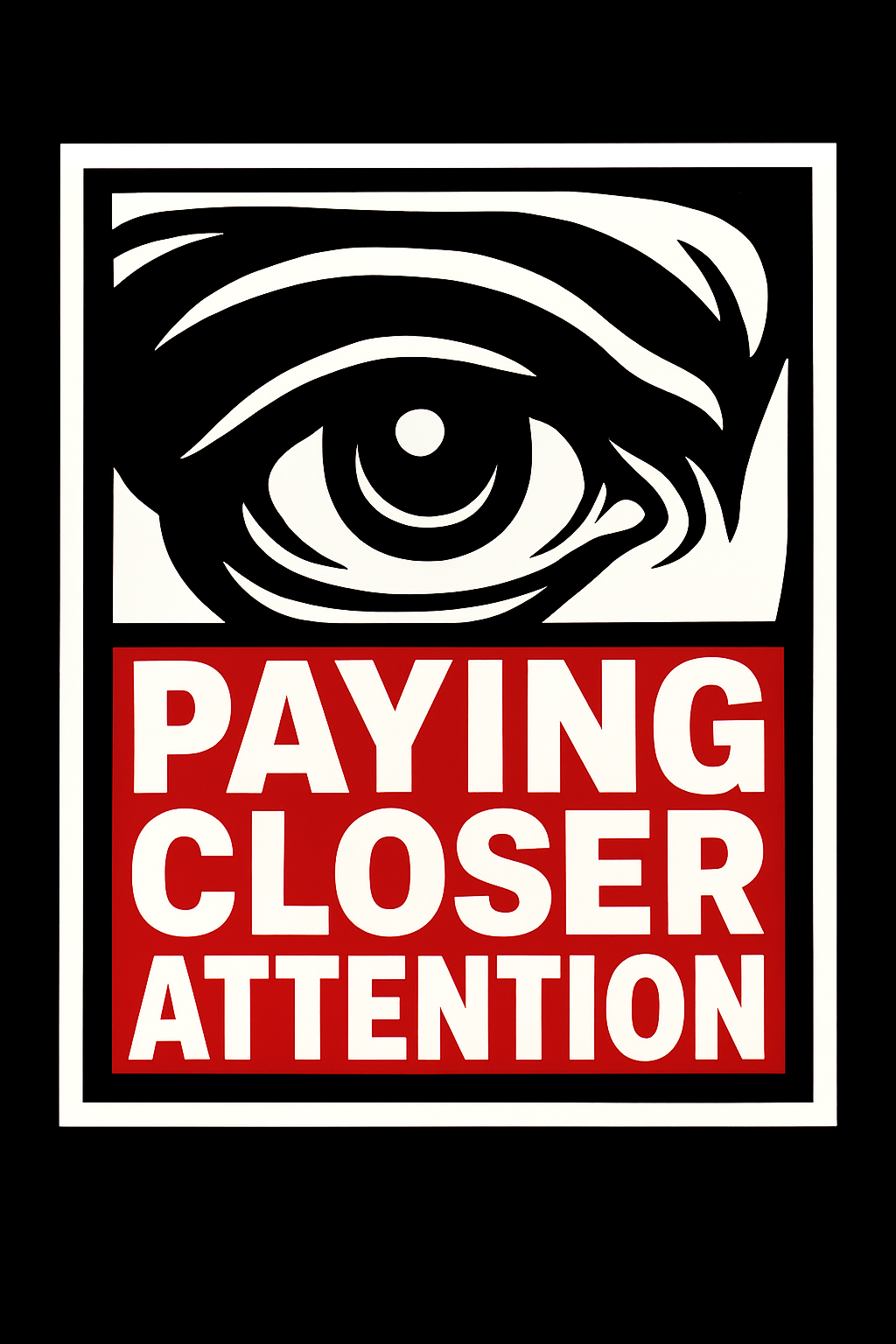
Yet uncertainty is not only a deficit to be overcome. It can also be an instruction to pay closer attention: to resist premature certainty, remain with what does not yet fit, and ask whether the people and systems seeking our trust can meet an unknowable future with honesty, adaptability and a willingness to repair. Rebuilding trust is not a matter of asking people to believe again, but of restoring the conditions in which trust can be earned and held robustly.
None of this removes uncertainty from voting. It offers something more modest: a way of paying attention to what our trust is supporting and how securely it is being held. We can look beyond seamless promises towards implementation, incentives, future consequences, fallback capacity and the possibility of repair. We can remain willing to trust without surrendering the responsibility to question.
Paying closer attention reveals what is being asked of our trust.
Collective attention allows claims and patterns to be examined together.
Public clarity creates better grounds for warranted trust.
Responsible participation is how we act without demanding impossible certainty.
Democracy does not ask us to choose between blind faith and permanent suspicion. It asks us to build the habits and institutions through which trust can be earned, tested, corrected and sometimes withdrawn. A vote is an act of trust. Paying closer attention is how we decide what deserves that trust - and how we learn to hold it robustly.